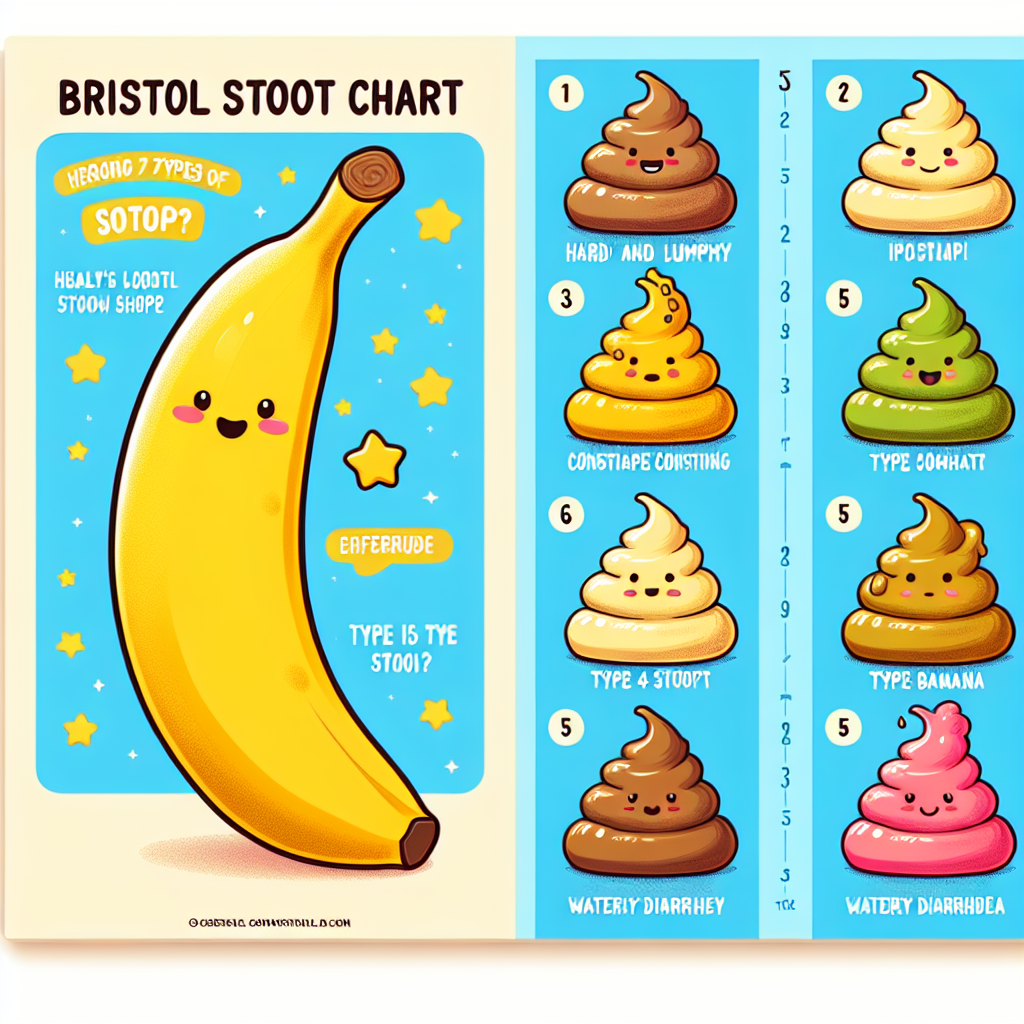

Spoiler: If your poop looks like a banana, you're probably doing something right. Here's why doctors want you to aim for that perfect sausage shape.
The Bristol Stool Chart: Your Poop Report Card
Let's talk about something everyone does but nobody wants to discuss at dinner parties: what your poop should actually look like.
Turns out, there's an actual scientific chart for this. It's called the Bristol Stool Chart, and it's basically a reference guide to poop shapes and consistencies. Think of it as the Pantone color guide, but for your bowel movements.
The chart ranks stools from Type 1 to Type 7:
- Types 1-2: Hard, lumpy, constipated nightmare fuel
- Types 3-4: The Goldilocks zone (more on this below)
- Types 6-7: Loose, watery diarrhea territory
According to gastroenterologists, Types 3 and 4 are what you're aiming for. And guess what shape those are?
Yep. Banana-shaped. Sausage-shaped. Snake-shaped. Whatever visual metaphor gets the point across.
“When you're having a normal bowel movement that's either type three or type four, it does kind of look like a sausage or a banana shape,” says Dr. Supriya Rao, a gastroenterologist in Massachusetts. “That's what we are aiming for with our patients.”
What Makes a Perfect Poop?
So what exactly qualifies as a healthy “banana poop”? Here's the checklist:
✅ Shape: Smooth and cylindrical
Not lumpy, not cracked, not a pile of pellets. Think smooth, continuous log shape — like a banana or sausage (or snake, if comparing poop to food gives you the ick).
✅ Consistency: Soft but holds its shape
It should be easy to pass — no straining, no effort, no pain. But it shouldn't be watery or formless, either. It's solid enough to maintain structure, but soft enough to exit without a struggle.
✅ Color: Brown (obviously)
We're not going deep into color science here, but brown is the goal. Any major deviations (black, red, pale) are worth mentioning to your doctor.
✅ Frequency: Regular
“Regular” varies by person, but anywhere from three times a day to three times a week is considered normal. Consistency matters more than frequency — if you're always Type 3 or 4, you're golden.
Why Fiber Is Your Bowel Movement's Best Friend
Here's the hard truth: Most Americans are not pooping like champions.
Why? Because the typical American diet is garbage (literally). Ultra-processed foods, animal products, low fiber intake — all of this leads to constipation, bloating, and poop that looks more like Type 1 rabbit pellets than a glorious Type 4 banana.
The Fiber Gap
Most people get around 8-10 grams of fiber per day. You know what you should be getting? 30-40 grams.
That's a massive gap. And fiber is the single most important dietary factor for achieving that perfect banana poop.
Why fiber matters:
- Adds bulk to stool — makes it easier to pass
- Speeds up digestion — keeps things moving through your system
- Feeds good gut bacteria — improves overall gut health
- Reduces colon cancer risk — one of the best preventive measures
Where to get fiber:
- Fruits (especially berries, apples, pears)
- Vegetables (broccoli, carrots, Brussels sprouts)
- Whole grains (oatmeal, whole wheat bread, brown rice)
- Legumes (lentils, chickpeas, black beans)
- Seeds (chia, flax, pumpkin)
Easy Fiber Hacks
You don't need to overhaul your entire diet. Start small:
- Sprinkle chia seeds on your oatmeal or smoothie (1-2 tablespoons = instant fiber boost)
- Swap white pasta for whole wheat — same taste, way more fiber
- Snack on blackberries or raspberries — nature's fiber bombs
- Make lentil soup — delicious, filling, fiber-packed
- Take a 10-15 minute walk after meals — helps digestion and motility
Dr. Rao recommends that post-meal walk: “It helps jump start digestion and allows, over time, people to not feel as bloated and to have better bowel movements.”
Why You Should Always Look Before You Flush
We know, we know. Looking at your poop is weird. But it's also one of the easiest ways to monitor your health.
“Taking a look before you flush can help you take note of things like blood in the stool, or black stools (which may signify old or digested blood), which should absolutely bring you to your health care professional for further evaluation,” says Dr. Sophie Balzora, a clinical professor at NYU Grossman School of Medicine.
What to Watch For
🚨 Blood in your stool
This can be a sign of hemorrhoids, anal fissures, or — in more serious cases — colon cancer. Don't ignore it. See a doctor.
🚨 Black, tar-like stools
This can indicate old or digested blood higher up in your digestive tract. Also a “see a doctor immediately” situation.
🚨 Pale or clay-colored stools
Could mean a bile duct issue or liver problem. Yep, doctor time.
🚨 Sudden, persistent changes in consistency or frequency
If you're normally a Type 4 banana pooper and suddenly you're stuck at Type 1 for weeks, something's up. If you're experiencing diarrhea that won't quit, same deal. Talk to your doctor.
The Colon Cancer Connection
Here's a sobering stat: Colon cancer is now the #1 cancer killer in people under 50.
It's becoming more common in younger adults, and doctors don't fully understand why. Lifestyle factors (diet, exercise, alcohol, smoking) play a role, but there's likely more to it.
Common colon cancer symptoms:
- Rectal bleeding
- Blood in stool
- Persistent abdominal pain
- Unexpected weight loss
- Anemia
- Changes in stool consistency or frequency
Actor James Van Der Beek (Dawson's Creek) recently died at 48 from colon cancer, highlighting just how serious this disease is — and how it's affecting younger people.
“It's just important to make sure that you're not ignoring symptoms,” says Dr. Rao. “A lot of young people think, ‘I'm too young for this,' but that's not the case anymore.”
The takeaway: If something feels off, talk to your doctor. Don't wait. Don't dismiss it. Get it checked.
Banana Poop Isn't the Holy Grail, But It's a Good Goal
Look, you're not going to have a perfect Type 4 banana poop every single time. And that's okay.
“A classic ‘banana-shaped stool' is not the holy grail, so it's not critical to aim for this consistency every time you have a bowel movement,” says Dr. Balzora. But it is a good barometer for gut health.
If you're consistently hitting Types 1-2 (hard, lumpy, constipated), you need more fiber and water.
If you're consistently at Types 6-7 (loose, watery), you might have IBS, food intolerances, or an infection.
If you're hanging out in the Type 3-4 zone most of the time? You're doing great. Keep it up.
Track Your Poop Like a Pro
Want to level up your digestive health game? Start tracking your bowel movements.
Use the FartRanker Fart Calculator to log your emissions, monitor patterns, and see how diet, hydration, and lifestyle choices affect your gut health. Because understanding your body is the first step to optimizing it.
And hey, if you're going to spend time thinking about your poop, you might as well make it fun.
Bottom line: Aim for banana poop. Eat more fiber. Look before you flush. And if something feels wrong, talk to your doctor. Because as Dr. Balzora says, “Everybody poops.”
Your gut health is no joke. Take care of it.